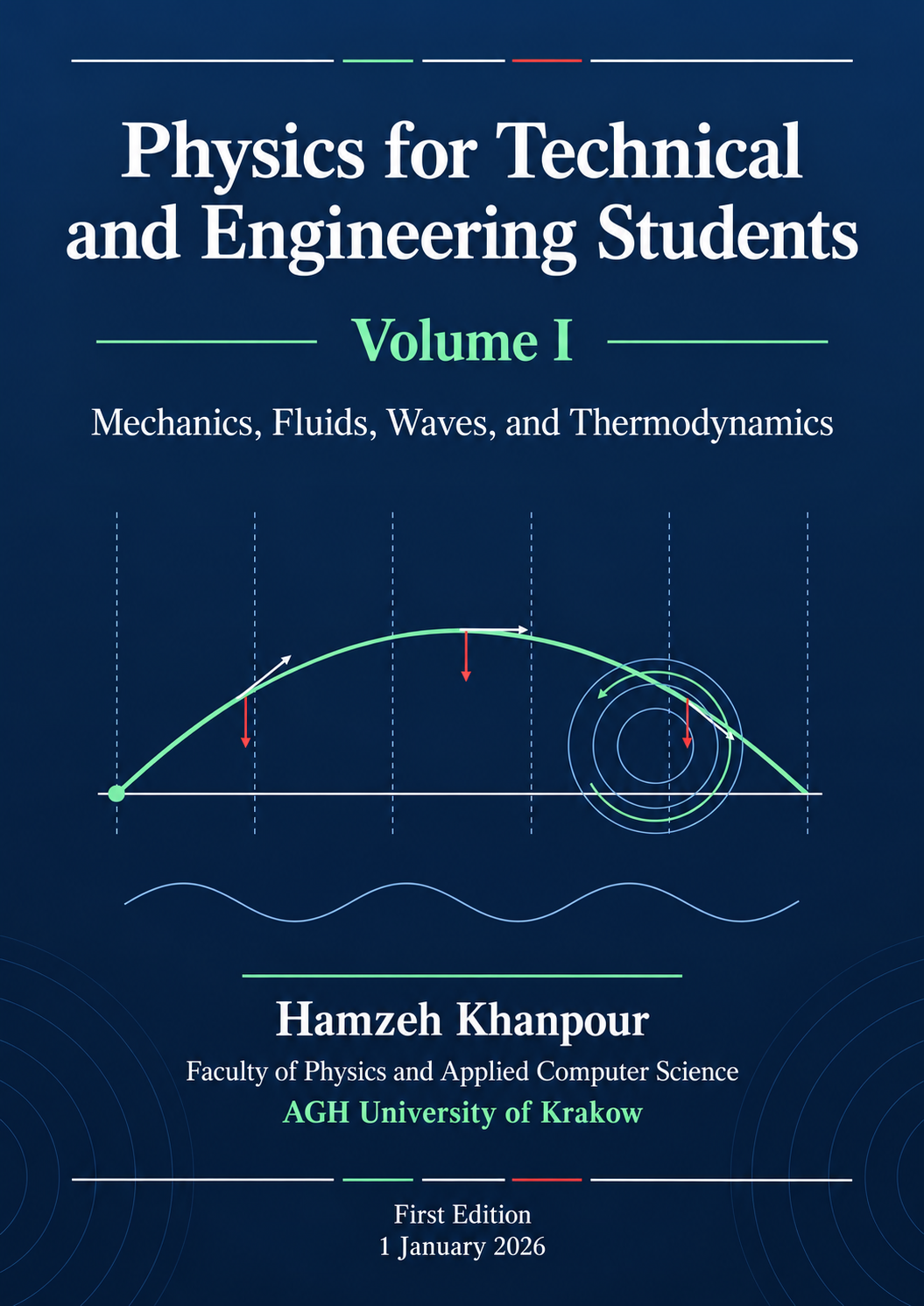
This course introduces the foundations of classical physics for students in technical, engineering, and applied-science programmes. It develops the physical language of measurement, vectors, motion, force, energy, momentum, rotation, fluids, oscillations, waves, and thermodynamics. The emphasis is on conceptual understanding, mathematical modelling, dimensional reasoning, problem solving, and the connection between physical principles and engineering applications.
The course begins with measurement and mathematical language, then develops kinematics and Newtonian dynamics, introduces conservation laws, extends mechanics to rotating and extended bodies, and finally treats gravitation, fluids, oscillations, waves, and thermodynamics.
Introductory course slides (PDF)
Core topics: Physical quantities, SI units, base and derived quantities, unit conversion, scientific notation, dimensional analysis, significant figures, order-of-magnitude estimates, density, and the role of measurement in physics.
This chapter establishes physics as a quantitative science based on measurement, modelling, and comparison with standards. It introduces the SI system, dimensional reasoning, and the importance of units in every physical equation. Students also learn how estimates and significant figures help connect mathematical answers to meaningful physical results.
Core topics: Position, displacement, distance, average velocity, average speed, instantaneous velocity, acceleration, constant-acceleration motion, free fall, and graphical analysis of motion.
This chapter introduces one-dimensional kinematics as the first systematic description of motion. It emphasises the differences between displacement and distance, velocity and speed, and average and instantaneous quantities. Graphs of position, velocity, and acceleration are used as central tools for interpreting motion.
Core topics: Scalars, vectors, components, unit vectors, vector addition and subtraction, scalar multiplication, scalar product, vector product, and physical examples of vector quantities.
This chapter provides the mathematical language needed for mechanics and later physics. Students learn how vector equations express coordinate-independent physical laws, while vector components allow practical calculations in chosen coordinate systems. The scalar and vector products are introduced through physical applications such as work and torque.
Core topics: Position vector, displacement vector, velocity vector, acceleration vector, projectile motion, uniform circular motion, and relative motion in one and two dimensions.
This chapter generalises kinematics to multidimensional motion. Projectile motion is treated as a central example of component decomposition, while circular motion shows that acceleration can occur even when speed is constant. Relative motion is introduced to clarify how descriptions of motion depend on the reference frame.
Core topics: Newtonian mechanics, force, mass, Newton's first law, Newton's second law, Newton's third law, free-body diagrams, gravitational force near Earth, normal force, tension, and simple applications.
This chapter introduces dynamics: the connection between forces and changes in motion. Free-body diagrams are developed as a systematic method for translating a physical situation into equations. The chapter emphasises modelling assumptions, inertial frames, and the correct interpretation of Newton's laws.
Core topics: Static friction, kinetic friction, drag force, terminal speed, uniform circular motion, centripetal acceleration, and force-based analysis of circular motion.
This chapter extends Newtonian dynamics to more realistic force models and constrained motion. Friction is treated carefully as a contact force with static and kinetic regimes. Circular dynamics is used to show that centripetal acceleration is produced by the net radial force, not by a new kind of force.
Core topics: Kinetic energy, work by a constant force, work by gravity, work by a spring force, work by a variable force, the work-energy theorem, and power.
This chapter introduces energy methods as an alternative and often more powerful approach to mechanics. Work is defined through the component of force along displacement and later generalised to variable forces. The work-energy theorem connects force-based dynamics with changes in kinetic energy.
Core topics: Conservative forces, potential energy, gravitational potential energy near Earth, elastic potential energy, mechanical energy, conservation of mechanical energy, energy diagrams, external work, and general energy conservation.
This chapter develops potential energy and conservation of energy. Students learn when mechanical energy is conserved, how non-conservative forces modify mechanical energy, and how energy diagrams can be used to understand motion qualitatively. The chapter stresses the distinction between conservation of total energy and conservation of mechanical energy.
Core topics: Center of mass, Newton's second law for systems of particles, linear momentum, impulse, conservation of momentum, elastic and inelastic collisions, two-dimensional collisions, and variable-mass systems as optional enrichment.
This chapter moves from single-particle mechanics to systems of particles. Momentum and impulse are introduced as central tools for analysing interactions and collisions. Conservation of momentum is treated as a system law, with careful attention to the distinction between internal and external forces.
Core topics: Angular position, angular displacement, angular velocity, angular acceleration, rotational kinematics, relations between angular and linear variables, rotational kinetic energy, moment of inertia, torque, Newton's second law for rotation, and rotational work.
This chapter introduces rigid-body rotation about a fixed axis. The analogy between translational and rotational motion is used to organise the theory, while the moment of inertia is introduced as the rotational analogue of mass. Torque is developed as the quantity responsible for angular acceleration.
Core topics: Rolling without slipping, kinetic energy of rolling, forces in rolling motion, torque revisited, angular momentum of a particle, angular momentum of a rigid body, Newton's second law in angular form, conservation of angular momentum, and gyroscopic precession as optional enrichment.
This chapter completes the basic treatment of rotational mechanics. Rolling motion is analysed as a combination of translation and rotation, and angular momentum is introduced as a conserved vector quantity. The chapter highlights the importance of choosing the system and axis carefully.
Core topics: Static equilibrium, force balance, torque balance, center of gravity, examples of static structures, stress, strain, Young's modulus, shear modulus, bulk modulus, and engineering applications.
This chapter applies Newton's laws and torque balance to extended bodies at rest. It develops the conditions for static equilibrium and introduces elasticity as the physics of deformable materials. The chapter is especially relevant for engineering students because it connects mechanics to structures and material response.
Core topics: Newton's law of gravitation, superposition of gravitational forces, gravitational field near Earth, gravitational potential energy, escape speed, orbital motion, Kepler's laws, satellites and orbital energy, and a brief conceptual note on Einsteinian gravity.
This chapter shows that the same mechanics developed for terrestrial motion also governs planetary and satellite motion. Newton's universal law of gravitation is connected to circular motion, energy conservation, and Kepler's laws. The chapter also offers a bridge to modern views of gravity as optional enrichment.
Core topics: Density, pressure, hydrostatic pressure, pressure measurement, Pascal's principle, Archimedes' principle, buoyancy, ideal fluids, continuity equation, Bernoulli equation, and limitations of ideal-fluid approximations.
This chapter introduces fluids as continuous media. Students learn how pressure varies with depth, how buoyancy arises, and how conservation ideas lead to the continuity and Bernoulli equations for ideal flow. The modelling assumptions behind ideal-fluid descriptions are stated explicitly.
Core topics: Simple harmonic motion, force law for SHM, angular frequency, period, frequency, energy in SHM, mass-spring oscillator, pendulums, damped oscillations, forced oscillations, and resonance.
This chapter introduces oscillatory motion as a universal model in physics and engineering. The simple harmonic oscillator provides the foundation for understanding periodic motion, resonance, and later wave phenomena. Energy methods are used to interpret the exchange between kinetic and potential energy during oscillation.
Core topics: Types of waves, transverse and longitudinal waves, wavelength, frequency, wave speed, travelling waves on a string, energy and power in waves, the wave equation, superposition, interference, standing waves, and resonance.
This chapter extends oscillatory motion to disturbances that propagate through space. Students learn the mathematical form of a travelling wave, the meaning of phase, and the relation between wavelength, frequency, and wave speed. Interference and standing waves introduce the central role of superposition.
Core topics: Sound waves, speed of sound, travelling sound waves, pressure and displacement variations, intensity, sound level, interference of sound, musical sound, beats, Doppler effect, and shock waves as optional enrichment.
This chapter applies wave ideas to sound and acoustics. The physical meaning of sound intensity and sound level is developed, together with interference, beats, and the Doppler effect. The chapter connects wave physics to everyday and engineering contexts such as acoustics, measurement, and moving sources.
Core topics: Temperature, thermal equilibrium, zeroth law, temperature scales, thermal expansion, heat, heat capacity, specific heat, latent heat, work in thermodynamic processes, internal energy, first law of thermodynamics, and heat transfer mechanisms.
This chapter introduces macroscopic thermodynamics. Students learn the distinction between temperature, heat, work, and internal energy, and use the first law to analyse energy transfer in thermal systems. Thermodynamic sign conventions and process diagrams are treated with care.
Core topics: Avogadro's number, ideal gas law, microscopic interpretation of pressure, rms speed, translational kinetic energy, temperature as molecular kinetic energy, mean free path, molecular speed distribution, molar specific heats, degrees of freedom, and adiabatic expansion.
This chapter connects macroscopic thermodynamics to microscopic mechanics. The ideal gas law is interpreted in terms of molecular motion, and temperature is related to average molecular kinetic energy. The chapter gives students a bridge between deterministic mechanics and statistical descriptions of matter.
Core topics: Irreversible processes, entropy, entropy change, second law of thermodynamics, heat engines, Carnot engine, refrigerators, real engines, efficiency, coefficient of performance, and the statistical interpretation of entropy.
This chapter completes the thermodynamics block by introducing irreversibility and the second law. Entropy is presented as a state function with both macroscopic and statistical meaning. Heat engines and refrigerators are used to show the fundamental limits on converting heat into work.