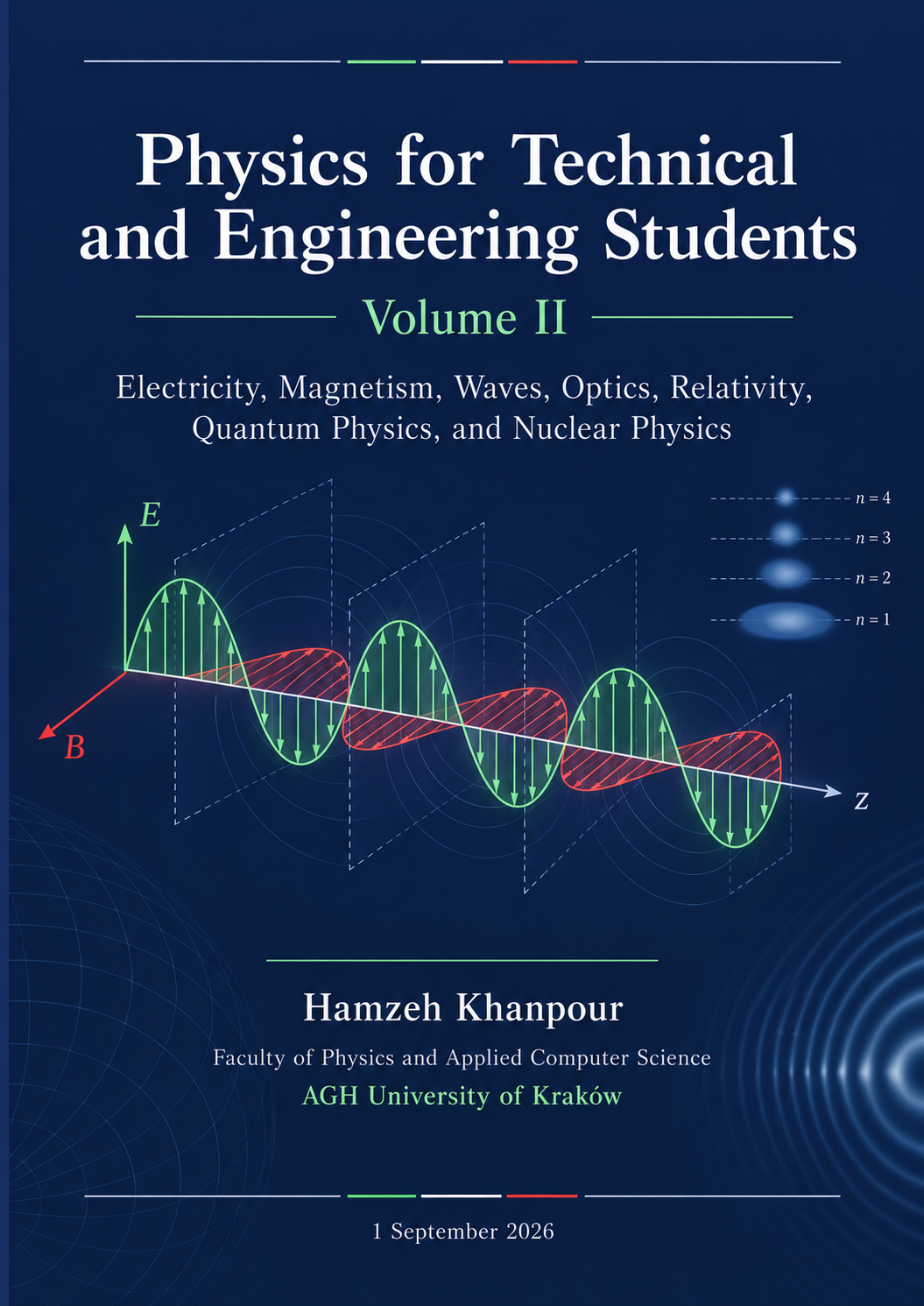
This course introduces the foundations of electricity, magnetism, electromagnetic waves, optics, relativity, quantum physics, atomic physics, solid-state physics, nuclear physics, and elementary particle physics for students in technical, engineering, and applied-science programmes. It develops the physical language of charge, field, potential, current, circuits, magnetic fields, induction, electromagnetic radiation, wave optics, spacetime, quantisation, matter waves, atomic structure, materials, nuclei, and fundamental particles. The emphasis is on conceptual understanding, mathematical modelling, problem solving, laboratory interpretation, and the connection between physical principles and modern scientific and engineering applications.
The course begins with electrostatics and the field concept, then develops electric potential, capacitance, current, and circuits. It continues with magnetism, electromagnetic induction, Maxwell's equations, and electromagnetic waves, before moving to geometrical optics, interference, diffraction, special relativity, quantum physics, atoms, solids, nuclei, nuclear energy, elementary particles, and a qualitative introduction to cosmology.
Introductory course overview slides (PDF)
Core topics: Electric charge, positive and negative charge, charge conservation, charge quantisation, conductors, insulators, charging by contact and induction, grounding, Coulomb's law, electrostatic force, superposition, and force diagrams for point charges.
This chapter introduces electric charge as a fundamental physical property and Coulomb's law as the starting point of electrostatics. Students learn how electric forces differ from contact forces and gravity, how charge is transferred and conserved, and why electrostatic forces must be treated as vectors. The chapter also establishes the microscopic role of electrons and the distinction between conductors and insulators.
Core topics: Electric field, test charge, field due to a point charge, electric field lines, superposition of electric fields, electric dipoles, continuous charge distributions, uniform electric fields, and the motion of charged particles in electric fields.
This chapter develops the electric field as a local description of electrostatic interaction. Students learn that a charged object modifies the space around it, and that a second charge responds to the field at its own position. Field lines are introduced as a visual representation of direction and relative strength, while superposition is used to calculate fields from several charges or simple charge distributions.
Core topics: Electric flux, area vectors, closed surfaces, Gaussian surfaces, Gauss's law, relation to Coulomb's law, spherical symmetry, cylindrical symmetry, planar symmetry, charged conductors, and electrostatic shielding.
This chapter introduces electric flux and Gauss's law as a compact expression of the relation between charge and electric field. The main emphasis is on symmetry: students learn when Gauss's law is useful for calculating electric fields and when it is mainly a conceptual statement. Conductors in electrostatic equilibrium are treated as an important application of the field concept.
Core topics: Electric potential energy, electric potential, potential difference, voltage, work done by electric forces, equipotential surfaces, potential due to point charges, potential due to a dipole, potential of continuous charge distributions, and the relation between electric field and potential.
This chapter introduces the energy language of electrostatics. Students learn the distinction between electric potential and electric potential energy, and they see why potential is often easier to calculate than electric field. Equipotential surfaces and the relation between potential gradients and electric fields provide a bridge from force-based reasoning to energy-based reasoning.
Core topics: Capacitance, parallel-plate capacitors, cylindrical and spherical capacitors, capacitors in series and parallel, energy stored in capacitors, electric-field energy density, dielectrics, dielectric constant, polarisation, and dielectrics in Gauss's law.
This chapter connects electrostatics to practical devices that store charge and electrical energy. Students learn that capacitance depends on geometry and material properties, and that dielectrics modify electric fields through polarisation. The chapter also prepares students for time-dependent circuits by introducing capacitors as ideal circuit elements.
Core topics: Electric current, current density, drift velocity, resistance, resistivity, conductivity, Ohm's law, microscopic model of conduction, electric power, Joule heating, semiconductors, and superconductors as introductory examples.
This chapter moves from electrostatics to charge transport. Students learn how microscopic carrier motion produces macroscopic current, why resistance depends on both material and geometry, and why Ohm's law is a material relation rather than a universal law. Electrical power and energy dissipation are treated as central links between circuits and energy conservation.
Core topics: Electromotive force, ideal and real batteries, single-loop circuits, potential differences in circuits, resistors in series and parallel, Kirchhoff's junction rule, Kirchhoff's loop rule, ammeters, voltmeters, RC circuits, charging and discharging capacitors, and time constants.
This chapter applies conservation of charge and conservation of energy to electrical networks. Students learn how circuit diagrams represent physical systems, how Kirchhoff's rules organise circuit analysis, and how capacitors introduce time dependence through charging and discharging processes. The chapter emphasises sign conventions, idealisations, and the physical meaning of voltage and current.
Core topics: Magnetic field, magnetic force on a moving charge, Lorentz force, crossed electric and magnetic fields, velocity selector, Hall effect, circular motion of charged particles, cyclotrons, synchrotrons, magnetic force on a current-carrying wire, torque on a current loop, and magnetic dipole moment.
This chapter introduces magnetic fields through the forces they exert on moving charges and currents. Students learn that magnetic forces are vector cross-product forces and are therefore perpendicular to both velocity and magnetic field. Applications such as the Hall effect and particle accelerators connect the formalism to measurement techniques and modern technology.
Core topics: Magnetic field due to a current, Biot-Savart law, magnetic field of a long straight wire, force between parallel currents, Ampere's law, solenoids, toroids, magnetic field of current loops, and current-carrying coils as magnetic dipoles.
This chapter completes the connection between electricity and magnetism by showing how currents generate magnetic fields. Students learn how the Biot-Savart law and Ampere's law are used in complementary ways, and why symmetry is essential for simple applications of Ampere's law. Solenoids and toroids provide important idealised models for engineering and laboratory systems.
Core topics: Magnetic flux, Faraday's law, Lenz's law, induced emf, motional emf, induction and energy transfer, induced electric fields, inductors, self-induction, RL circuits, energy stored in magnetic fields, magnetic energy density, and mutual induction.
This chapter introduces electromagnetic induction as the physics of changing magnetic flux. Faraday's law gives the magnitude of induced emf, while Lenz's law fixes its direction through energy conservation. Inductance is introduced as the circuit property associated with magnetic-field energy and opposition to changes in current.
Core topics: LC oscillations, electrical-mechanical analogy, energy exchange between capacitors and inductors, damped RLC oscillations, alternating current, capacitive reactance, inductive reactance, impedance, series RLC circuits, resonance, average power, rms values, power factor, and transformers.
This chapter connects electromagnetism with oscillations and resonance. Students learn how LC and RLC circuits behave like mechanical oscillators, how alternating-current circuits depend on frequency, and why phase relations are essential for understanding power. Transformers provide a major application of induction and AC physics.
Core topics: Gauss's law for magnetic fields, absence of magnetic monopoles in classical electromagnetism, induced magnetic fields, displacement current, Ampere-Maxwell law, Maxwell's equations in integral form, permanent magnets, orbital and spin magnetic moments, diamagnetism, paramagnetism, ferromagnetism, and magnetic domains.
This chapter presents classical electromagnetism as a unified theory. Students learn how Maxwell's displacement current completes Ampere's law and allows changing electric fields to produce magnetic fields. Magnetism in matter is introduced qualitatively through the microscopic magnetic moments of electrons and their collective behaviour in materials.
Core topics: Electromagnetic waves, wave speed, relation between electric and magnetic fields, electromagnetic spectrum, energy transport, Poynting vector, intensity, radiation pressure, polarisation, reflection, refraction, Snell's law, total internal reflection, and polarisation by reflection.
This chapter shows that Maxwell's equations predict electromagnetic waves and identifies light as one part of the electromagnetic spectrum. Students learn how oscillating electric and magnetic fields sustain one another and transport energy through space. Reflection, refraction, total internal reflection, and polarisation connect electromagnetic theory to optics and technology.
Core topics: Ray model of light, plane mirrors, spherical mirrors, real and virtual images, focal points, mirror equation, spherical refracting surfaces, thin lenses, lens equation, magnification, optical instruments, cameras, magnifiers, microscopes, and telescopes.
This chapter introduces geometrical optics as the short-wavelength approximation to wave propagation. Students learn how mirrors and lenses form images, how sign conventions are used consistently, and how ray diagrams translate physical geometry into quantitative predictions. Optical instruments provide practical applications of image formation.
Core topics: Light as a wave, phase, coherence, superposition, Young's double-slit experiment, constructive and destructive interference, intensity in double-slit interference, interference from thin films, phase changes on reflection, and Michelson's interferometer.
This chapter introduces interference as direct evidence of the wave nature of light. Students learn how path difference and phase difference determine bright and dark fringes, and why coherence is required for a stable interference pattern. Thin-film interference and interferometry show how wave optics leads to precision measurement and practical optical effects.
Core topics: Single-slit diffraction, diffraction minima, intensity in single-slit diffraction, diffraction by a circular aperture, Rayleigh criterion, diffraction by a double slit, diffraction gratings, dispersion, resolving power, and X-ray diffraction.
This chapter shows that diffraction is an unavoidable consequence of wave propagation through finite apertures. Students learn how aperture size controls angular spreading and how diffraction sets fundamental limits on optical resolution. Diffraction gratings and X-ray diffraction connect wave optics to spectroscopy and the structure of matter.
Core topics: Postulates of special relativity, inertial frames, events, relativity of simultaneity, time dilation, proper time, length contraction, proper length, Lorentz transformation, relativistic velocity addition, Doppler effect for light, relativistic momentum, relativistic energy, rest energy, and mass-energy equivalence.
This chapter introduces the relativistic structure of space and time. Students learn that measurements of time intervals and lengths depend on the inertial frame, while the speed of light is invariant. Momentum and energy are reformulated for high-speed particles, providing an essential bridge to modern physics and particle physics.
Core topics: Photon energy, photoelectric effect, work function, photon momentum, Compton scattering, light as a probability wave, de Broglie wavelength, matter waves, electron diffraction, Schrödinger equation at an introductory level, Heisenberg uncertainty principle, reflection from a potential step, and tunnelling through a potential barrier.
This chapter introduces quantum physics through phenomena that cannot be explained by classical wave or particle models alone. Students learn how light exhibits particle-like behaviour, how matter exhibits wave-like behaviour, and why probability amplitudes replace classical trajectories at microscopic scales. The chapter provides the conceptual foundation for atoms, solids, and nuclei.
Core topics: Standing matter waves, particle in an infinite well, quantised energy levels, wave functions, probability density, finite wells, tunnelling in bound systems, two- and three-dimensional traps, hydrogen atom, Bohr model as a historical approximation, Schrödinger treatment of hydrogen, quantum numbers, and atomic energy levels.
This chapter develops the idea that confinement leads to quantisation. Students use standing-wave reasoning and simple boundary conditions to understand discrete energy levels, then connect these ideas to the hydrogen atom. The chapter stresses that quantum states describe probability distributions rather than classical orbits.
Core topics: Atomic properties, angular momentum, magnetic dipole moments, Stern-Gerlach experiment, spin, magnetic resonance, Pauli exclusion principle, many-electron atoms, periodic table, characteristic X-rays, stimulated emission, population inversion, laser operation, and properties of laser light.
This chapter applies quantum ideas to the structure and behaviour of atoms. Students learn how angular momentum, spin, exclusion, and energy levels explain spectra and the organisation of the periodic table. Lasers are introduced as a major technological application of stimulated emission and controlled atomic transitions.
Core topics: Electrical properties of solids, energy levels in crystalline solids, energy bands, metals, insulators, semiconductors, band gaps, doping, n-type and p-type semiconductors, p-n junctions, junction rectifiers, light-emitting diodes, transistors, and electronic-device applications.
This chapter connects quantum physics to the electrical behaviour of materials. Students learn how band structure determines whether a solid behaves as a conductor, insulator, or semiconductor, and how doping can control charge carriers. The p-n junction, LED, and transistor illustrate how microscopic quantum structure leads to modern electronic technology.
Core topics: Discovery of the nucleus, nuclear size, nuclear charge, mass number, atomic number, isotopes, nuclear density, binding energy, radioactive decay, decay constant, half-life, activity, alpha decay, beta decay, gamma decay, radioactive dating, radiation dose, and nuclear models.
This chapter introduces the structure and instability of atomic nuclei. Students learn how nuclear size and binding energy reveal a new short-range interaction, and how radioactive decay is described statistically. Conservation laws are used to analyse nuclear reactions, while radiation dose and dating applications connect nuclear physics to technology, medicine, and the environment.
Core topics: Nuclear fission, fission fragments, chain reactions, criticality, energy release, nuclear reactors, moderators, control rods, reactor power, natural nuclear reactors, thermonuclear fusion, fusion in stars, proton-proton chain, controlled fusion, plasma confinement, and energy-production challenges.
This chapter applies nuclear binding energy to large-scale energy production. Students learn why both fission of heavy nuclei and fusion of light nuclei can release energy, and how reactors use controlled chain reactions. Stellar fusion and controlled fusion show how nuclear physics connects microscopic reactions to astrophysics and future energy technologies.
Core topics: Elementary particles, antiparticles, leptons, hadrons, mesons, baryons, quarks, quark charges, strangeness, conservation laws, particle classification, fundamental interactions, messenger particles, expanding universe, cosmic microwave background, dark matter, Big Bang model, and open questions in modern physics.
This chapter provides a broad final synthesis of modern physics. Students learn how particles are classified, how hadrons are built from quarks, and how fundamental interactions organise microscopic phenomena. The chapter closes by connecting particle physics with cosmology, showing how the early universe provides a natural setting for high-energy physics.