
Technology
Hardware Component Design
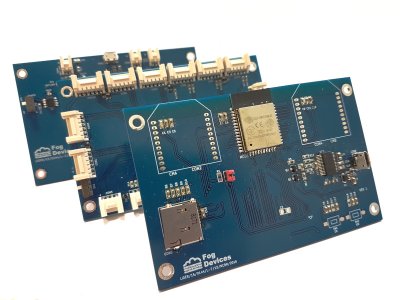
The modular design of the devices will allow the creation of solutions tailored to the specific application from previously prepared modules. Appropriate selection of communication systems, calculation processor, sensors and power supply depends on the specific application of the device:
- communication module - it is important whether the device should have direct access to the Internet and what properties communication between devices should have,
- power module - the device can be powered from conventional or renewable sources, the way of charging devices can also be important,
- computational module - the innovation is the inclusion in the management platform of nodes both built based on embedded processors and application processors,
- sensors / effectors - will include both domain sensors (e.g. for agriculture, monitoring of air and water quality), as well as allowing connection to typical automation systems (e.g. 4-20mA, 0-10V), and e.g. classic outputs relay.
FogFlow programming model
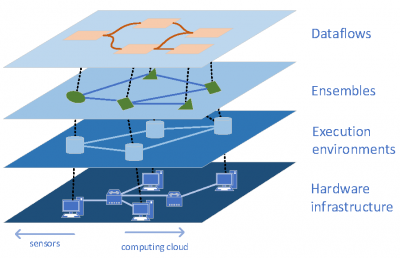
The research is focused on the design and development of the platform for creating Internet of Things devices based on the fog computing paradigm. The platform enables processing of data not only in the computing cloud, but also closer to the source – directly on sensor devices, with a view towards reducing communication overhead, facilitating local processing and contextualizing operations.
Internet of Things systems are becoming more and more diverse in terms of architecture. The IoT devices are the sources of data streams that must be processed. The FogFlow programming model which is under the development allows for organization of data-flow applications to be run in the heterogeneous execution environments available on various types of devices.
The high level logic implemented using FogFlow API is mapped to the resources available on devices in the edge and the cloud and then deployed and executed taking into account various quality assurance metrics. The process also includes the transfer learning technique enabling inference using ML models on devices with limited resources. The conducted research is of great importance for the development of modern and intelligent Internet of Things systems.
Machine Learning
One of the important aspects in the industrial IoT is the response time of the systems. For example, in the factory automation, motion control and tactile In- ternet the acceptable latency is less then 10ms. It means that the IoT systems using machine learning algorithms in the cloud for that kind of applications are not sufficient due to the fact that Internet routing to the worldwide datacenters introduces signicant delays.
One of the solutions to circumvent that drawback is to move machine learning algorithms to the edge of the network e.g. to the data center located in the factory and learn only on the local data. As a result, the latency introduced by the communication protocol would be signicantly smaller because limited to the local networks, but the gained knowledge would be incomplete. The promising improvement would be to perform machine learning in the cloud environments on a large volume of data and then send learned models to the edge datacenters in order to make predictions locally e.g. in the factories. That approach would increase the accuracy of the predictions due to the variety of sources that data came from in the learning process.
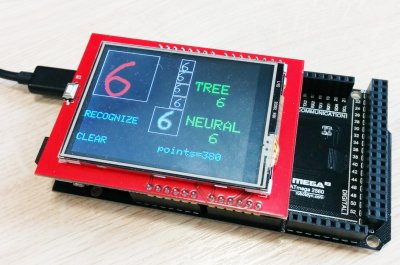
Nevertheless, even with that approach, the devices have to be constantly connected to the local computer network in order to use the machine learn- ing models. Thus, in the research we are moving machine learning models to the embedded devices itself. In our concept, instead of implementing machine learning libraries for embedded devices that can read and interpret the learned models, they are converted to the source code that can be compiled in the de- vice rmware. This enables possibility to embed the these models into embedded processors that may have sporadic access to the network. We are providing source code generators for Bayes Networks, Decision Trees and MLP Neural Networks.
Environment Emulator
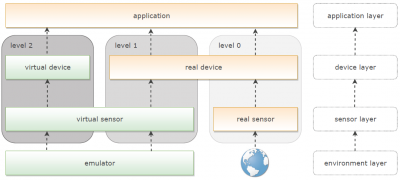
We have developed the testbed aimed at end-to-end testing of IoT systems from the application point of view. The proposed testbed is meant for testing high-level application protocols and interaction with cloud services rather than analyzing low-level nuances of e.g. medium access control in wireless communications. The main idea behind the proposed testbed is to immerse the components under test in a virtual environment imitating real-world conditions. We therefore ground our approach in simulating real-world environments, devices and sensors which, on the one hand, does not require custom hardware for application development, while on the other hand permits integration with existing IoT hardware devices depending on the maturity of the tested IoT system.
Contact
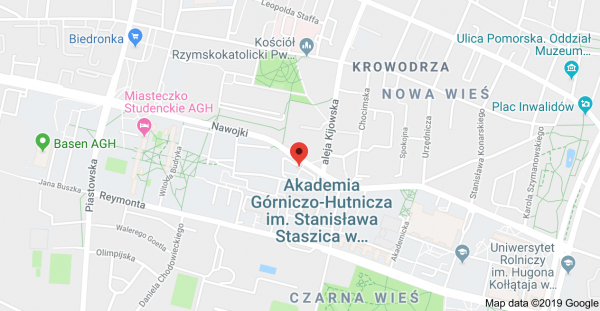
AGH University of Science and Technology
Department of Computer Science
Building D17
Kawiory 21 street
30-055 Krakow
e-mail: tszydlo at agh.edu.pl