
All News & Updates
A collaborative study presented at IEEE IUS 2026 in Raleigh, 4-8 October 2026
October 2026A collaborative study involving representatives from the University of Massachusetts Amherst, Mayo Clinic, Michigan State University and our group was presented at the 2026 IEEE International Ultrasonics Symposium (IUS) in Raleigh, North Carolina, USA. The conference was held on 4-8 October, 2026.
The presentation, entitled Characterization of Crosslinking-Dependent Elasticity in Soft Hydrogels with Acoustic Force Elastography Microscopy, was delivered by Prof. Hsiao-Chuan Liu. The work focused on the use of acoustic force elastography microscopy to characterize elasticity changes in soft hydrogels associated with different levels of crosslinking.

International Tissue Elasticity Conference in Leipzig, 23-25 September 2026
September 2026We presented our work entitled Two-Point Model-Free Estimation of Shear Wave Attenuation in Ultrasound Elastography at the International Tissue Elasticity Conference (ITEC 2026), held on September 23-25, 2026, in Leipzig, Germany. The presentation focused on a model-free two-point approach for estimating shear wave attenuation in ultrasound elastography.

Joining the Editorial Board of Medical Acoustics and Imaging
September 2026Piotr Kijanka has joined the Editorial Board of Medical Acoustics and Imaging. The journal covers research in medical acoustics, ultrasound, biomedical imaging, elastography, and related areas. This appointment recognises his research activity in ultrasound elastography, medical imaging, signal processing, and numerical modelling. In his new role, he will contribute to the peer-review process and support the development of high-quality research in these fields.

New article published in IEEE Transactions on Ultrasonics
September 2026Our new article, Robust Two-Point Attenuation Coefficient Estimation Using Kullback-Leibler-type Divergence for Ultrasound Shear Wave Elastography, has been published in IEEE Transactions on Ultrasonics. The study introduces 2PACK, a robust, model-free two-point method for estimating shear wave attenuation using Kullback-Leibler-type divergence. The method was validated using analytical models, tissue-mimicking phantoms, and ex vivo bovine liver, demonstrating improved robustness, particularly under challenging low-signal conditions.

New US patent granted for broadband shear wave elastography
September 2026A new US patent (US 12,714,401 B2), developed jointly by our group at AGH University of Krakow and Mayo Clinic, has been granted for a method used for shear wave phase velocity estimation over an extended frequency bandwidth.

The 1st IEEE Central and Eastern European Ultrasonics Symposium in Warsaw, 22-24 June 2026
June 2026Our group presented two research works at the IEEE CEEUS 2026 Conference:
- Two-Point Model-Free Estimation of Shear Wave Attenuation for Ultrasound Elastography - presented by Ramin Almasi.
- Ex Vivo Investigation of Shear Wave Dispersion Estimation Using the Superlet Transform - presented by Wiktor Jachym.

23rd Annual NeuroTech Convention of SBMT in Los Angeles, 16-19 April 2026
April 2026Piotr Kijanka attended the SBMT 2026 conference in Los Angeles as a member of the organizing committee for the Biomechanics, Biomaterials, and Tissue Engineering session.
In addition, he gave an Invited Talk titled: 2D Phase Velocity Elastography Over an Extended Frequency Band for Viscoelastic Biomaterial Characterization.

52nd DAGA Acoustic Conference in Dresden, 23-26 March 2026
March 2026Our group presented two research works at the DAGA Acoustic Conference:
- Sources of Variability in Shear Wave Elastography of Soft Tissues - Invited Talk presented by Piotr Kijanka.
- Experimental Evaluation of a Time-Frequency Method for Dispersion Curve Estimation in Shear Wave Elastography - presented by Wiktor Jachym.

23rd Annual NeuroTech Convention of SBMT in Los Angeles, 16-19 April 2026
November 2025The biggest Society for Brain Mapping and Therapeutics (SBMT) Neurotech Congress yet is coming to Los Angeles. For four days, global leaders in MedTech, AI Tech, BioTech, CellTech and PharmaTech will shape the future of brain health.
Piotr Kijanka is on the organizing committee for the Biomechanics, Biomaterials, and Tissue Engineering session, which reflects the growing interdisciplinary impact of the areas. This annual event brings together a multidisciplinary community of scientists, clinicians, engineers, policymakers, and industry leaders dedicated to advancing innovations.

52nd DAGA Acoustic Conference in Dresden, 23-26 March 2026
November 2025For the DAGA Acoustic Conference, to be held on March 23–26, 2026, our colleague Łukasz Ambroziński together with Piotr Kijanka are organizing a session titled Biomedical Ultrasound. This section focuses on recent developments in quantitative ultrasound imaging for biomedical applications. These developments include ultrasound elastography techniques, signal processing algorithms, and deep learning methods for solving image formation and reconstruction problems. The scope of the section remains open to other innovative and interdisciplinary contributions relevant to medical imaging and diagnostics.

Internship at Mayo Clinic in Rochester, MN
November 2025Our lab member, Wiktor, completed a six-week research internship at Mayo Clinic in Rochester, one of the world’s leading hospitals. During his internship, Wiktor was involved in:
- Acquiring datasets from different soft materials using the programmable ultrasonic research system.
- Performing validation steps to ensure data quality and reliability.
- Working on, validating, and improving a new signal processing algorithm for Shear Wave Elastography.
- Observing a variety of ongoing lab experiments and taking part in several studies.
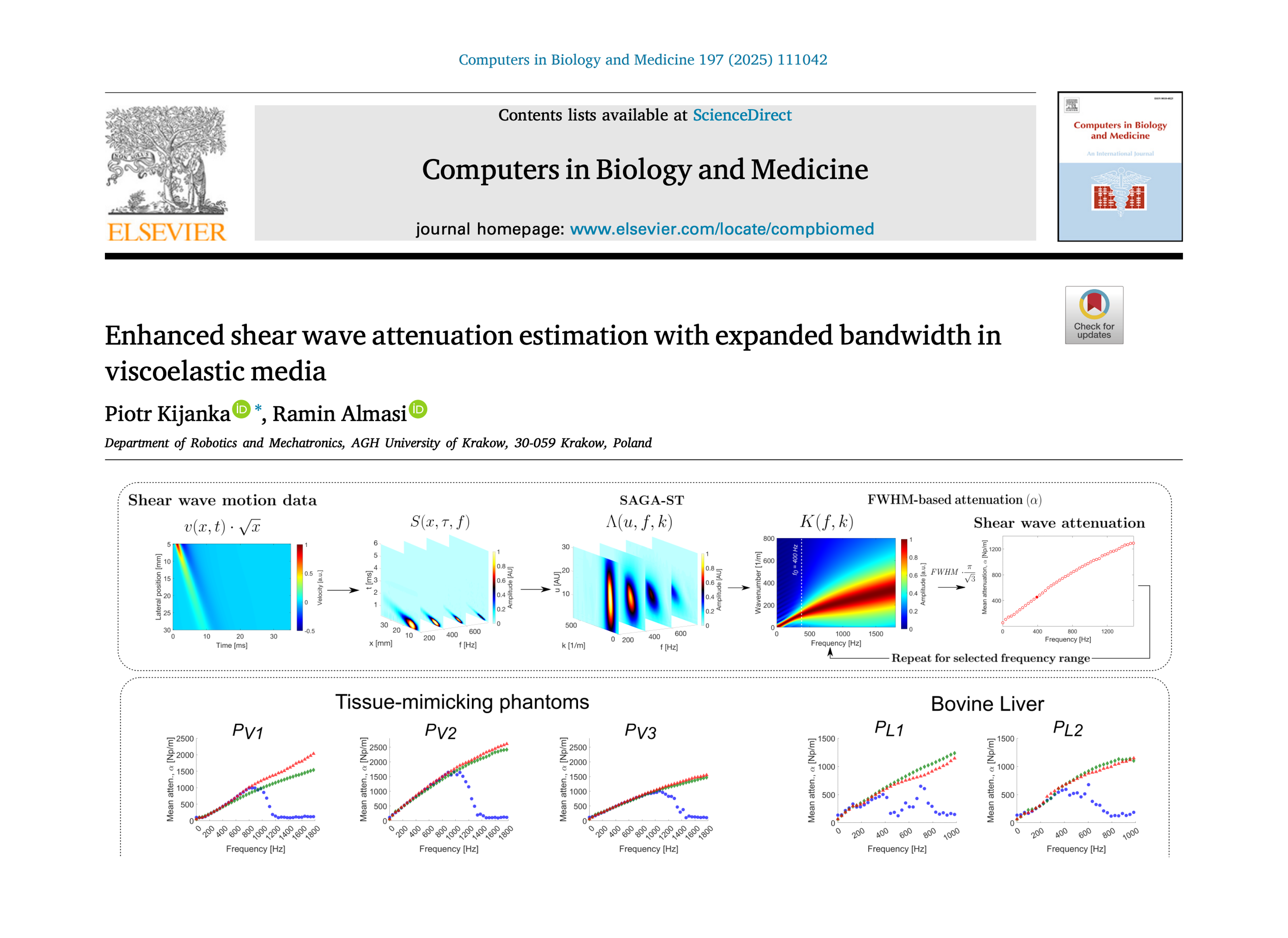
New article accepted in Computers in Biology and Medicine
October 2025Our latest research on measuring shear wave attenuation has been published in Computers in Biology and Medicine. This study presents a novel method for evaluating shear wave attenuation using the SAGA-ST approach. The method was validated on analytical data, TM phantoms, and ex vivo tissue experiments. Compared to the 2D-FT and GST-SFK techniques, SAGA-ST demonstrated superior performance, providing lower estimation errors and enabling attenuation assessment over an extended frequency bandwidth. This enhanced bandwidth may facilitate an improved differentiation of viscoelastic materials, particularly at higher frequencies where contrast is more pronounced.

The IEEE IUS 2025 conference, Utrecht, Netherlands
September 2025Our group presented three research works at the 2025 IEEE International Ultrasonics Symposium:
- Shear Wave Attenuation Calculation Using Modified Stockwell-transform-Based Method.
- Local Phase Velocity Imaging with Wavenumber Filter Banks for Improved Low Frequency Shear Wave elastography.
- Reconstructing Shear Wave Dispersion Curves Using Time-Frequency Analysis and Limited Field-of-View Data.

New article accepted in Computer Methods and Programs in Biomedicine
June 2025This paper presents a novel approach for generating 2D shear wave phase velocity images, referred to as LPVI-WBF. This method produces local phase velocity maps closer to the B-mode true shapes and more accurate phase velocity values than existing approaches such as LPVI at low frequencies, as validated by results obtained from inclusion phantoms. Furthermore, for stiffer inclusions, which are of great importance in clinical applications, LPVI-WBF provides a higher contrast-to-noise ratio (CNR) at low frequencies (i.e. below 500 Hz). The proposed method employs an adaptive technique with a 2D Custom Fourier transform (2D CFT) and a 2D Custom Inverse Fourier transform (2-D CIFT), which effectively reduces processing time and memory usage. Variants of the LPVI-WF method enhance the quality of phase velocity maps by improving both the CNR and the accuracy of phase velocity values. Future research will focus on examining viscoelastic materials.

27th Acoustic and Biomedical Engineering Conference
April 2025Piotr Kijanka delivered an invited talk at the 27th Acoustic and Biomedical Engineering Conference in Zakopane, Poland. His presentation focused on the challenges associated with assessing tissue mechanical properties using ultrasound shear wave elastography.

The International Student Grant from the Acoustical Society of America
January 2025Wiktor received the International Student Grant from the Acoustical Society of America (ASA). The ASA provides grants annually to students enrolled in acoustic research programs at universities or technical institutes in developing countries.

A new patent for phase velocity imaging has been granted in both the US and Japan
January 2025New patents for phase velocity imaging have been granted in both the US (US 12,078,612 B2) and in Japan (JP 7,610,502 B2). The European patent is still pending (EP 3,861,368 A1). This invention was developed during Piotr Kijanka's long-term visit to the Mayo Clinic.

New article accepted in Ultrasonics
January 2025This paper presents a novel technique, PL-SWE, for reconstructing shear wave phase velocity dispersion curves and highlights its effectiveness. The study shows that PL-SWE can accurately reconstruct phase velocity dispersion curves in elastic and viscoelastic phantoms, as well as in vivo renal transplant data, with RMSPE values below 6%. Unlike the 2D-FT method, which requires a large number of data points in the lateral direction to produce reliable results, PL-SWE achieves accurate reconstructions with a minimal number of signals (at least two). In addition, the PL-SWE method provides more reliable results than the PG approach for data with low SNR.

Elastography Challenge at the UFFC-JS 2024 in Taipei, Taiwan
September 2024Our advanced methods for analyzing shear wave motion - Ultrasound Shear Elastography with Expanded Bandwidth (USEWEB) and Local Phase Velocity Imaging (LPVI) — were recognized among the top approaches in the Elastography Challenge at the 2024 IEEE UFFC Joint Symposium held in Taipei, Taiwan.
The objectives of this challenge were:
- To challenge the community to devise more accurate and precise algorithms for elastic modulus estimation (via detection and characterisation of propagating shear waves).
- To raise greater awareness of the challenges associated with elastic modulus estimation, and to gain further knowledge on why certain approaches fail.
- To identify the most promising approaches to elastic modulus estimation.
- To provide a benchmark and public data for the future development of SWS and elastic modulus estimation algorithms.

Interview on Radio Kraków
May 2024Piotr Kijanka was interviewed on Radio Kraków, where he spoke about his research carried out in collaboration with leading international scientific institutions.

A new technique for non-contact measurement of the elastic properties of cell-encapsulated scaffolds
May 2024Piotr Kijanka is part of a team led by the University of Southern California. The team has received an R21 award to develop two-dimensional acoustic force elastography microscopy, which will enable the non-contact measurement of the elastic properties of cell-encapsulated scaffolds.