
Research
Summary
Our research focuses on developing advanced ultrasound- and optics-based methods for quantitative elasticity and viscosity imaging in biological tissues. We aim to understand and quantify the mechanical and viscoelastic properties of tissue using advanced signal processing, numerical modeling, and experimental imaging methods. Current projects involve shear wave elastography (SWE), acoustic radiation force (ARF) imaging, optical coherence elastography (OCE), and the analysis of viscoelastic material properties for biomedical applications. We also explore numerical modeling and AI-assisted image analysis for improved diagnostic precision.
Focus Areas
Tissue characterization and elasticity imaging
Among the various methods used for shear wave elastography (SWE) there are numerous techniques for reconstructing the mechanical properties. Most methods are based on measuring the time-of-flight of the shear wave in a local sense. We have proposed two methods to generate images of the phase velocity in soft tissues, i.e. local phase velocity-based imaging (LPVI) and the newly proposed ultrasound shear elastography with expanded bandwidth (USEWEB). The motivation is to create an optimal method to reconstruct the shear wave velocity of small inclusions in the frequency domain without overestimating the lesion dimension, as well as to create phase velocity images in viscoelastic soft tissues. The USEWEB and LPVI techniques open new possibilities for noninvasive imaging and characterization of pathologies of viscoelastic tissues.

Wave dispersion reconstuction for tissue viscoelasticity estimation
Typically, SWE uses an acoustic radiation force to produce laterally propagating shear waves that are tracked in the spatial and temporal domains, in order to obtain the wave velocity. Most SWE methods measure the shear waves at multiple locations simultaneously for one or multiple acquisitions. One of the ways to study the viscoelasticity is through studying the shear wave phase velocity dispersion curves for shear wave responses acquired over multiple laterally-spaced spatial points. We have proposed various, robust methods for shear wave phase velocity dispersion estimation (GST-SFK, MUSIC, Eigenvector). GST-SFK uses a generalized Stockwell transformation combined with a slant frequency-wavenumber analysis to provide expanded bandwidth to be used for phase velocity estimation. MUSIC uses the multiple signal classification technique to provide robust estimation of the k-space and phase velocity dispersion curves. The motivation is to create methods for viscoelasticity estimation at higher frequencies where separation may be more distinct due to dispersion.

Estimation of tissue viscoelasticity for a limited field of view (FOV)
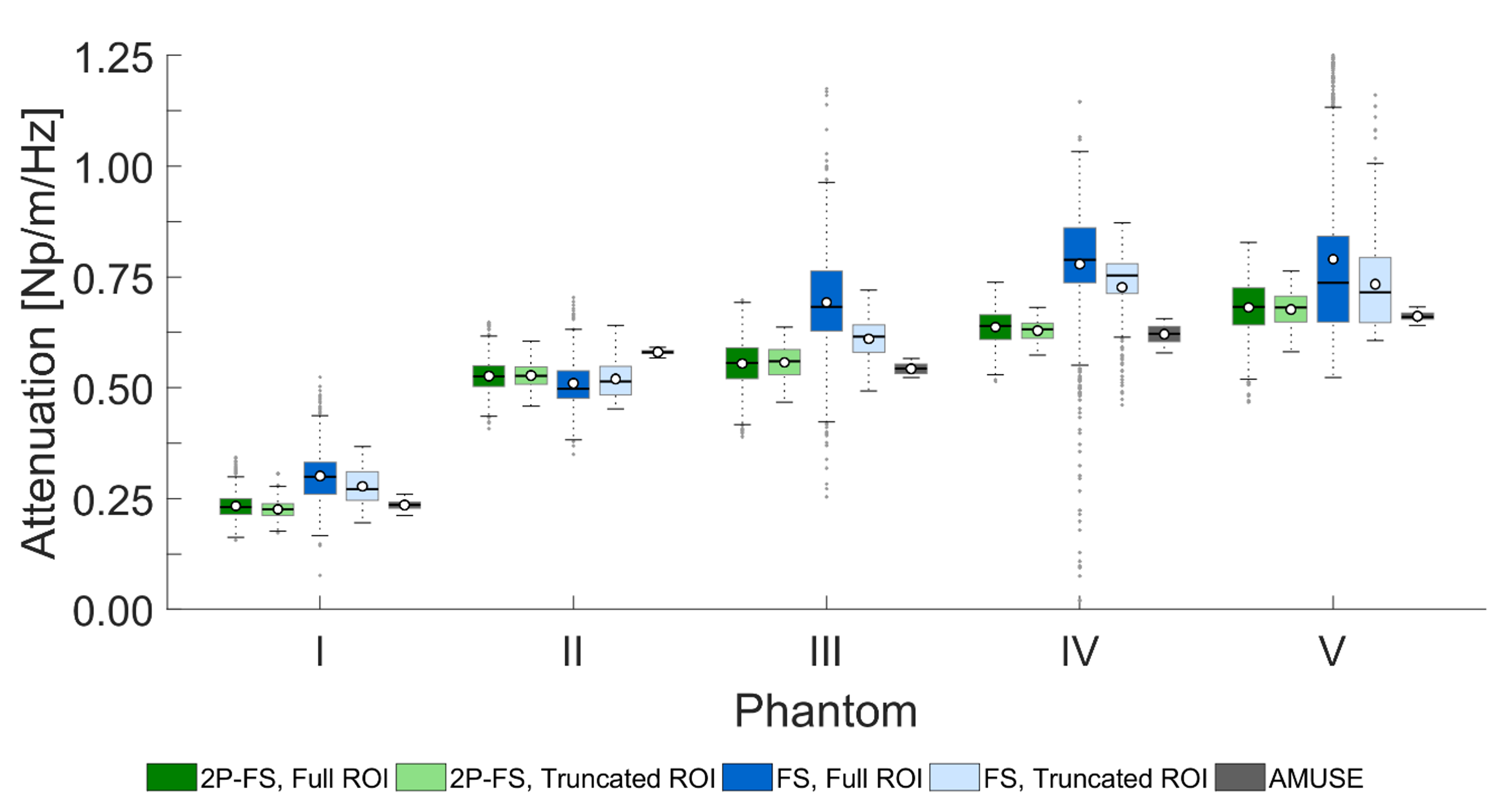
Most SWE methods require shear wave responses acquired over multiple laterally-spaced spatial points. This means that the resulting dispersion curves describe averaged material properties over a lateral segment. In practical applications, however, local properties are sought. We have proposed various, robust methods for shear wave phase velocity dispersion estimation (PL-SWE, 2P-CWT), and shear wave attenuation measurement (2P-FS, 2P-FSP). PL-SWE, 2P-CWT, 2P-FS and 2P-FSP use shear waves measured at only two lateral locations to properly reconstruct viscoelastic parameters. The motivation is to create methods for viscoelasticity estimation in scenarios where shear waves decay very fast and do not propagate over a long distance hence only a limited amount of data is available.
Numerical modeling and simulations
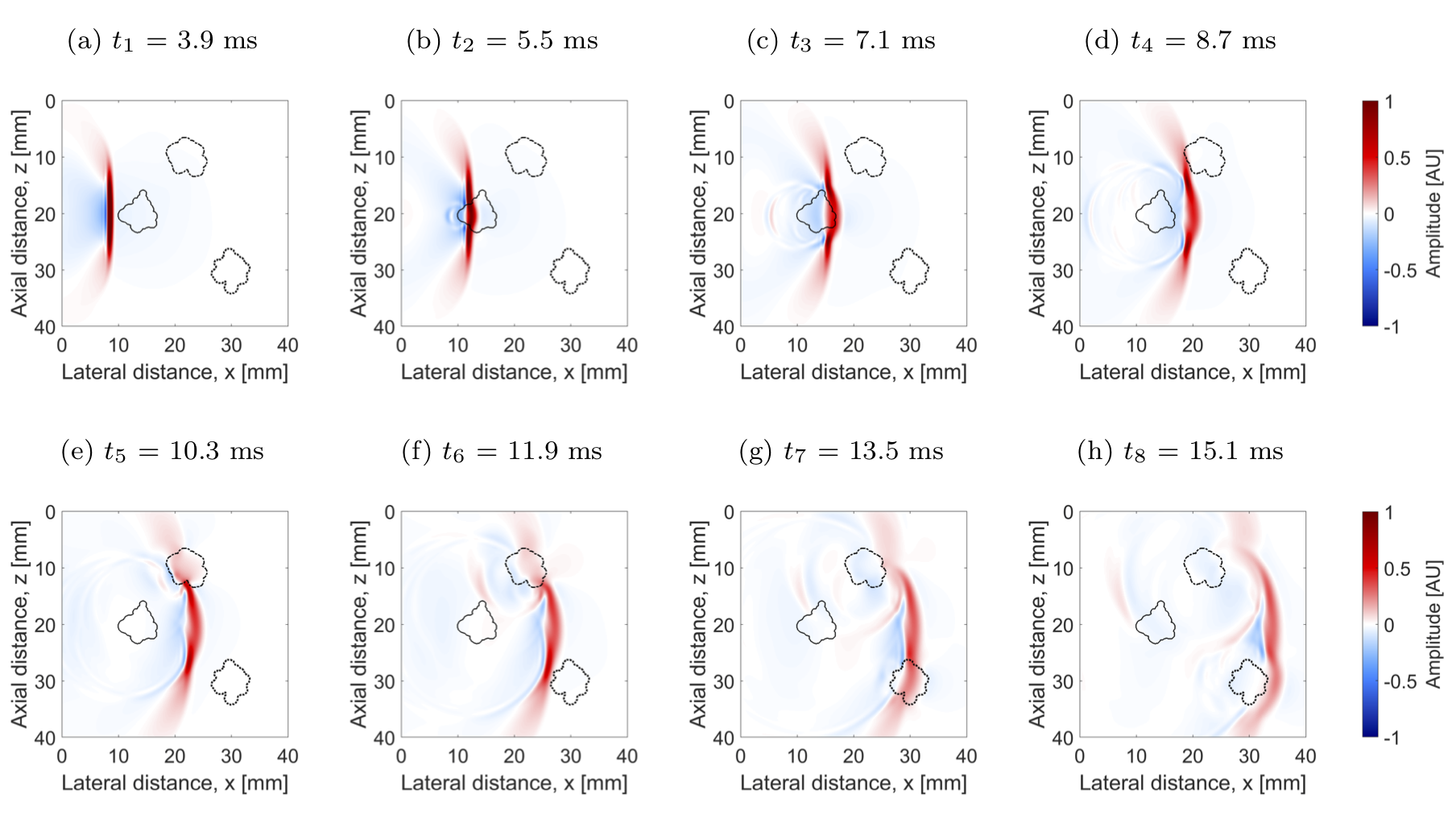
We use finite difference (FDM) and finite element modeling (FEM) along with other computational methods to simulate ultrasound propagation, acoustic radiation force effects, and shear wave behavior in complex viscoelastic media. These simulations help optimize experimental setups and interpret imaging data.
Funding Sources



Collaborators
- Prof. Matthew W. Urban, Mayo Clinic – Department of Radiology
- Prof. Hsiao Chuan-Liu, University of Southern California – Department of Ophthalmology, Keck School of Medicine
- Prof. Martyna Elas, Jagiellonian University – Department of Biophysics and Cancer Biology
- Prof. Martyna Krzykawska-Serda, Jagiellonian University – Department of Biophysics and Cancer Biology
- Dr. Marcin Lewandowski, us4us Ltd.